
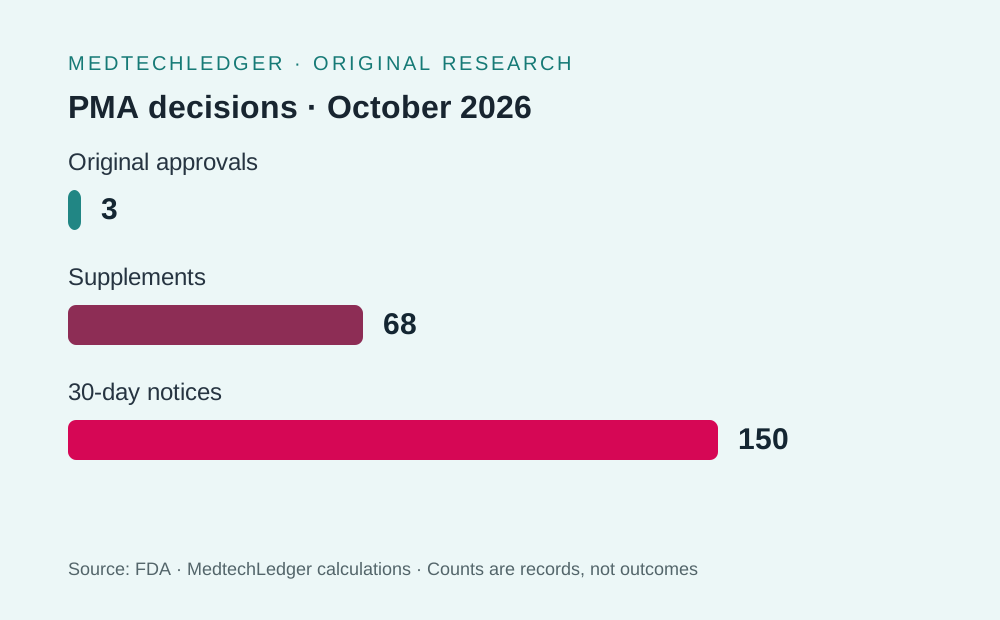
The figures behind this report
Complete responses returned by openFDA for the two specified monthly cohorts. September and October use the same inclusion field: decision date. Source releases: 2026-11-09 and 2026-11-09. Retrieved November 20, 2026 (Asia/Kuala Lumpur).
| Measure | September 2026 | October 2026 |
|---|---|---|
| Original PMA approvals | 4 | 3 |
| PMA supplement approvals | 73 | 68 |
| 30-day notices (OK30) | 110 | 150 |
Counts describe this dataset and snapshot. Applicant and firm names are exact source strings, without parent-company consolidation. Event totals are distinct within each month; the same event may appear in both monthly cohorts.
MedtechLedger’s complete decision-date pull for October 2026 contains 221 PMA records: 3 original approvals, 68 APPR supplements, and 150 records with supplement type 30-Day Notice. September 2026 contained 187 records with 4 originals, 73 supplements, and 110 records coded OK30. That is a month-to-month change in composition, not a basis for any longer-run trend claim. The counts below are MedtechLedger calculations from the complete openFDA PMA responses, using decision_date as the inclusion rule and the source-update date of 2026-11-09 for both monthly FDA snapshots [1][2].
What the October cohort contains
The October cohort is the full openFDA PMA response for decision dates from 2026-10-01 through 2026-10-31, retrieved by MedtechLedger on 2026-11-19 and matched to 221 records. MedtechLedger identifies 3 original approvals and 68 supplement approvals inside that total; the remaining 150 records carry the code OK30. Separately, the supplement-type count contains 150 records labeled 30-Day Notice [1].
That mix matters because the count is not a simple approvals-versus-notices split. The same October snapshot also reports 137 families, and the mix by supplement type is led by 30-Day Notice at 150, followed by Real-Time Process at 22, Normal 180 Day Track No User Fee at 19, Normal 180 Day Track at 13, Special (Immediate Track) at 6, 135 Review Track For 30-Day Notice at 5, Panel Track at 3, and Original at 3 [1].
The public FDA PMA page is the correct database context for this analysis: PMA records are searchable by Decision Date, Supplement Type, and other fields, and the page was last updated on 2026-11-09 [6]. Our October totals describe the response retrieved on November 19, with November 9 shown as its FDA source-update date [1].
How October differs from September
Compared with September 2026, October has 34 more total records, 1 fewer original approval, 5 fewer supplement approvals, and 40 more records with supplement type 30-Day Notice. September’s complete snapshot contained 187 records, 4 originals, 73 supplement approvals, and 110 records coded OK30 [2].
Those are descriptive differences in two adjacent monthly cohorts. October’s higher total is driven mainly by the larger OK30 count, while the original-approval and supplement-approval counts both moved down from September to October [1][2]. The snapshot alone does not tell you whether that reflects application timing, FDA processing cadence, or any other operational reason; it only shows the decision-date distribution in each month [1][2].
The most defensible way to read the pair is as a composition change. In September, OK30 accounted for 110 of 187 records; in October, OK30 accounted for 150 of 221 records. Original approvals remained a small slice in both months, at 4 in September and 3 in October [1][2].
Suggested workflow for using the CSV and query links
A practical internal workflow is to open the complete October query, verify the 221-row population, then group each downloaded CSV by decision_code and supplement_type, then compare the two grouped totals. The October file is linked at /data/research/fda-pma-october-2026.csv, and the September file at /data/research/fda-pma-september-2026.csv; both are tied to the openFDA query on decision_date [1][2].
For a month-over-month review deck, keep the language at the cohort level: October had 3 originals, 68 APPR supplements, and 150 records coded OK30; September had 4 originals, 73 APPR supplements, and 110 records coded OK30. That phrasing stays inside the data and avoids turning the counts into a regulatory conclusion [1][2].
How the supplements are coded
FDA’s PMA supplement materials distinguish original PMAs from supplements and amendments. The agency states that a PMA amendment includes additional submissions before approval or correspondence after approval, and that after FDA approves a PMA, an applicant must submit a supplement before making a change that affects safety or effectiveness unless FDA permits another submission type [3].
The supplement guidance also sets out the 30-day notice path for certain manufacturing-method or process changes. It says the change may be made 30 days after FDA receives a complete 30-day notice unless FDA says the notice is inadequate; if the notice is not adequate but contains data that fit the supplement content requirements, it can convert to a 135-day PMA supplement [3][4].
That context is useful for reading the October counts without stretching them. An APPR decision code in the snapshot does not mean the same thing as an original approval across all rows; the source data also separates supplement types, including 30-Day Notice, Real-Time Process, Normal 180 Day Track, Special (Immediate Track), Panel Track, and Original [1][5].
Why 221 records cannot be read as 221 new device approvals
MedtechLedger’s October table reports 150 records coded OK30 and 3 original approvals. The 221 records should be read as a mixed monthly cohort: the dataset includes supplements, notices, and originals in the same monthly response [1][5].
FDA’s PMA review page describes PMA approval as a distinct action within the review process, and it notes that original PMAs and PMA supplements are both subject to standard conditions of approval [8]. That is a reminder that a monthly PMA decision-date file is a mixed regulatory dataset, not a list of newly launched products [1][8].
The openFDA field reference describes decision codes and supplement types as separate fields [5]. Our October calculation reports 150 records with supplement type 30-Day Notice. It separately reports 150 values coded OK30 [1]. The notice category in this analysis follows the explicit supplement-type label; the decision-code tally preserves the literal values returned by the API. The two fields should remain separate when another researcher groups the downloadable records [1][5].
Checks on the calculations and method
Check 1: the October total reconciles exactly. 3 original approvals + 68 supplement approvals + 150 records coded OK30 = 221 records, which matches the reported population [1].
Check 2: the September total also reconciles exactly. 4 original approvals + 73 supplement approvals + 110 records coded OK30 = 187 records, which matches the reported population [2].
Check 3: the month-over-month change in total records is 34, because 221 minus 187 equals 34 [1][2]. Check 4: the change in original approvals is minus 1, because October’s 3 originals are one fewer than September’s 4 [1][2]. Check 5: the change in supplement approvals is minus 5, because October’s 68 is five fewer than September’s 73 [1][2].
Check 6: the change in records with supplement type 30-Day Notice is plus 40, because October’s 150 is forty more than September’s 110 [1][2]. Check 7: the source-update date is the same for both monthly FDA snapshots, 2026-11-09, so the comparison uses a common update reference point even though retrieval timestamps differ [1][2][6]. Check 8: both monthly pulls are described by MedtechLedger as complete populations, not samples, which means the counts are whole-month records from the openFDA response rather than estimates [1][2].
What the numbers can and cannot support
These counts support a precise monthly inventory, nothing more. They do not establish product performance, approval quality, market share, adoption, or sales [1][2]. They also do not justify a claim that October represents a durable shift, since the question spans only two adjacent months and two monthly observations cannot establish a long-term pattern.
The denominator is the monthly decision-date cohort, not all PMAs on file and not all PMA activity in a calendar year. Inclusion is based on decision_date within 2026-10-01 to 2026-10-31 for October and 2026-09-01 to 2026-09-30 for September [1][2]. Because the source is the PMA decision-date response, records are grouped by the date FDA made the decision, not by filing date or launch date [5][8].
For readers comparing regulatory workloads, that distinction matters. A single monthly snapshot can show how many decisions landed in the period and how those decisions were coded, but it does not by itself explain why the mix shifted [1][2].
Sources & references
- MedtechLedger calculation from the complete FDA october 2026 pma response · api.fda.gov
- MedtechLedger calculation from the complete FDA september 2026 pma response · api.fda.gov
- PMA Supplements and Amendments | FDA · www.fda.gov
- 30-Day Notices, 135-Day Premarket Approval (PMA) Supplements and 75- Day Humanitarian Device Exemption (HDE) Supplements for Manufacturing Method or Process Changes · www.fda.gov
- Section Field Name Type Description This equates to the review division within CDRH in which the PMA would be reviewed, · open.fda.gov
- Premarket Approval (PMA) · www.accessdata.fda.gov
- 30-Day Notices, 135-Day Premarket Approval (PMA) Supplements and 75-Day Humanitarian Device Exemption (HDE) Supplements for Manufacturing Method or Process Changes | FDA · www.fda.gov
- PMA Review Process | FDA · www.fda.gov